Why some people simply can’t afford to distance themselves from it.
While some people do their best to avoid Divisoria, others travel great distances just to get there.
Versions of this story have been told many times whenever discussions about the commercial sub-district surface. In a report by ABS-CBN this year, two individuals said they traveled from Bataan—approximately 133 kilometers from Manila—just to buy Christmas gifts. In an article from GRID, a vendor recounted that she had customers who came from even more distant provinces, including Benguet and Aurora.
But to some, Divisoria isn’t an ideal destination. In Metro Manila, for instance, there are people who wouldn’t go near it even if it were within walking distance. Some even choose to stay home during busy periods, especially in the holidays. “There are too many people outside,” said Lydia Chu, who lives on a street feeding Divisoria’s foot traffic. “It’s noisy, it’s crowded, and it doesn’t smell nice. I’d rather not.”
Of course, avoidance is a luxury for some. Many do not have that option, given what Divisoria truly offers: the ability to cope.
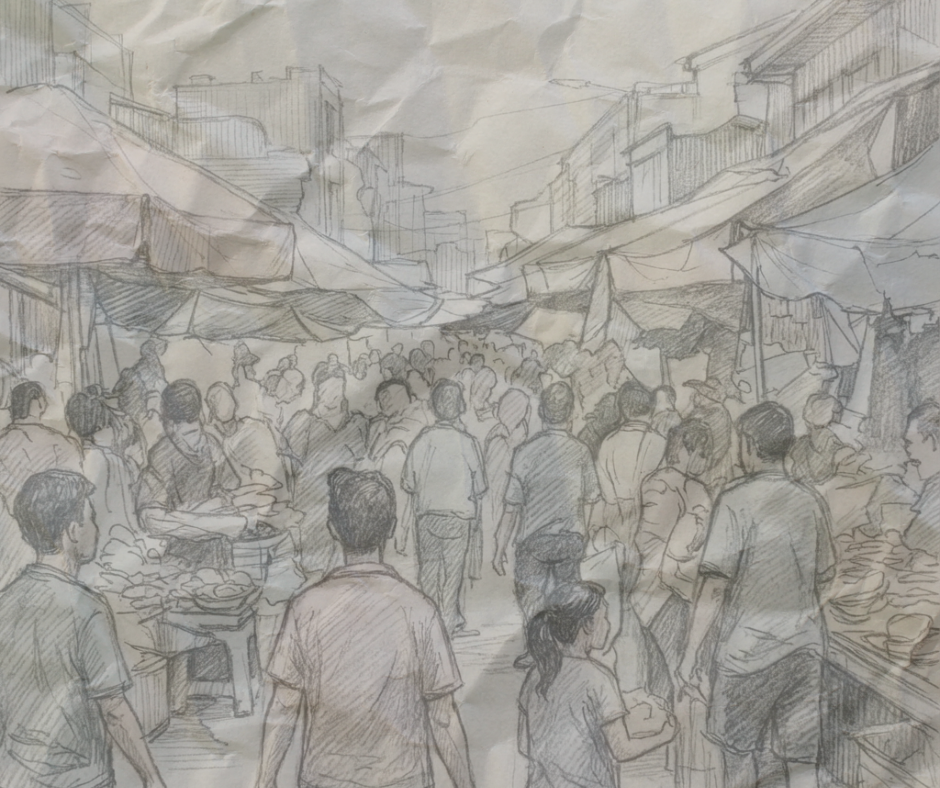
Spanning about half a square kilometer, Divisoria loosely straddles the districts of Tondo, Binondo, and San Nicolas. It is known for wholesale and low-cost retail, supplying everything from garments and housewares to food and raw materials—products that have helped people survive lean times. Its cheap prices, however, come with a drawback: chaos. Alleys are clogged with pedestrians, vehicles, and handcarts jostling for space, while vendors call out their wares over the din. Makeshift stalls spill into the streets, piled high with colorful merchandise, creating a labyrinth where navigating requires both patience and instinct.
These days, going to Divisoria means finding jeans as cheap as 300 pesos and toys worth about a hundred. But it also demands fortitude—the will to endure the narrow paths people snake through just to avail of such bargains.
Shaped by its proximity to the old port and Binondo’s trading networks, Divisoria developed as a practical marketplace serving small businesses, vendors, and working households. Its density and disorder are functional, allowing goods to move quickly and cheaply through informal yet established systems. More than a bargain destination, Divisoria operates as a logistics center for the city’s lower-priced economy, connecting networks through retail—a subtle irony given its history.
The Boundary
Established during the Spanish colonial era, the name “Divisoria” reflects the market’s earliest purpose and evolving identity. In Spanish, división means “division” or “boundary,” and the area originally referred to spaces separating plots of land in Tondo and Binondo. Strategically located between Intramuros, the seat of Spanish colonial power, and the Parián, the Chinese merchant district, Divisoria functioned as a practical buffer—an intermediary zone where goods, people, and ideas moved between the walled city and the trading hub. What began as a literal boundary gradually became a space of connection, where neighborhoods, social classes, and even provinces intersected in the bustling flow of commerce.
As Manila’s population grew and trade intensified, Divisoria became more than a series of intersecting streets. By the early 20th century, it had evolved into a dense, open-air commercial hub, attracting Chinese merchants, local vendors, and small-scale manufacturers. Its name, once tied to separation, now embodied convergence: alleys once defined by property lines became arteries of trade, where textiles, toys, household items, and food changed hands rapidly. In this sense, Divisoria’s etymology mirrors its paradoxical character—organized disorder, a place of division that thrives on connection.
During periods of scarcity, especially in the postwar decades, Divisoria’s role expanded further. It became not just a site for buying and selling but a center for survival and ingenuity. Vendors repurposed warehouses, sidewalks swelled with temporary markets, and entire supply chains emerged in the narrow lanes between buildings. Despite—or perhaps because of—its chaotic layout, Divisoria accommodated the city’s growing appetite for low-cost goods, sustaining families, small businesses, and local economies.
In this way, Divisoria’s identity as the intermediary space between Intramuros and the Parián is inseparable from its history. From a mere boundary to a symbol of Manila’s commercial ingenuity, it demonstrates how geography, language, and human enterprise converge to create a marketplace that is historically grounded yet vibrantly alive. Even today, its name evokes both the tangible divisions of colonial land planning and the intangible connections forged in everyday commerce, linking the power corridors of Intramuros, the merchants of the Parián, and the streets of Tondo and Binondo where trade continues to pulse.
The Breach
In the contemporary era, Divisoria has seen several milestones shaping its modern identity. The establishment of Tutuban Center in the 1990s transformed the area by blending wholesale trade with a formal shopping complex anchored around the old railway station. Eventually, Victory Mall, 168 Shopping Mall, and 999 Shopping Mall emerged along adjacent streets, creating a hybrid environment where traditional street stalls coexist with air-conditioned commercial centers. These layers of growth have allowed vendors to expand their reach while offering shoppers more structured options without losing the market’s signature bargains. Night markets and seasonal bazaars continue to enhance Divisoria’s reputation as a hub of accessibility and variety, especially during peak periods like Christmas and back-to-school season.
Beyond retail, Divisoria functions as a logistical center for small enterprises and informal networks. Wholesalers, suppliers, and small manufacturers rely on its dense trade network to distribute goods efficiently across Metro Manila and neighboring provinces. The proliferation of bulk shops and specialized warehouses reinforces its role as more than a shopping destination—it is a nexus connecting producers, retailers, and consumers throughout the country. Despite urban redevelopment, regulatory enforcement, or infrastructure changes, Divisoria’s character persists: a bustling, improvisational marketplace where commerce, ingenuity, and community intersect.
Yet contemporary Divisoria is not without its problems. The very density and improvisation that make it efficient also cause congestion, safety hazards, and environmental concerns. Narrow streets, often clogged with vendors, tricycles, delivery trucks, and throngs of shoppers, create bottlenecks that slow movement and heighten accident risks. The informal layout of stalls can impede emergency access, leaving little room for fire trucks, ambulances, or police vehicles in times of crisis.
Sanitation is another persistent challenge. Trash accumulates quickly in crowded lanes, exacerbated by food stalls and high foot traffic. Inadequate drainage systems struggle during the rainy season, resulting in flooding that disrupts trade. The mingling of solid waste, food scraps, and stagnant water occasionally produces unpleasant odors, adding to the market’s sensory intensity.
Security and petty crime also persist. Pickpocketing, snatching, and minor scuffles are not uncommon, particularly during peak shopping periods. While vendors and local authorities have developed informal vigilance systems, the scale of foot traffic makes policing difficult, leaving some shoppers wary.
Even commercial modernization has not fully resolved these challenges. Malls such as Tutuban Center, Lucky Chinatown, and 828 Shopping Mall have introduced order, air-conditioning, and formal retail spaces, yet the streets outside remain as congested and chaotic as ever. For many, the contrast between organized malls and surrounding alleys underscores Divisoria’s inherent tension: simultaneously modernizing and stubbornly improvisational, vibrant yet unwieldy.
In short, Divisoria’s contemporary issues are inseparable from the qualities that make it indispensable. Its density, noise, disorder, and imperfect infrastructure reflect its role as a lifeline for small businesses and bargain seekers. For every shopper who relishes the thrill of snaking through crowded alleys for a good deal, there is a resident or casual visitor navigating the frustrations of congestion, hygiene concerns, and improvisation hazards.
This, of course, is not new in the Philippines. For the longest time, the country was home to creative and ambitious individuals who helped it grow. Yet some have used their ingenuity to exploit the system, bending or breaking laws for personal gain. Political corruption, from embezzlement to patronage networks, concentrates wealth and resources in the hands of a few, leaving many others with limited options. Ironically, this dynamic produces at least two kinds of people: those who can afford to avoid Divisoria, and those who cannot.